Why Crankshaft Grinding Is a Specialized Process
A crankshaft is not a shaft. The crankpins and main journals sit on different axes, with throws between them. To grind a crankpin to size and still keep the journal concentric to the original axis — the requirement for the crank to spin without vibration — the grinder has to drive the workpiece from a steady rest, index around the throws, and treat every pin as a separate OD grinding operation while the rest of the shaft is geometrically locked.
Done wrong, the crank throws unevenly. Done right, the journal roundness is under 0.002 mm, cylindricity under 0.003 mm, and surface finish under Ra 0.2 μm, with the crankpin-to-main-journal concentricity at the level required for the engine to run smoothly for hundreds of thousands of kilometers.
This guide explains how crankshaft grinders work, the types available, and what to check when buying one. For an overview of cylindrical grinding in general, see Cylindrical Grinding Machine: The Workhorse of Precision Shaft Grinding.
How a Crankshaft Grinder Works
The crankshaft is clamped in two work heads — one at each main journal or on centers — and supported along its length by a steady rest that travels with the wheel. The work head carries a special drive dog that indexes the shaft to expose each crankpin to the grinding wheel in turn.
Three motions drive the process:
Wheel rotation at 30–45 m/s peripheral speed. Crankshaft wheels are usually straight wheels 600–900 mm in diameter.
Workpiece rotation at controlled RPM, set so the journal surface speed is in the 20–60 m/min range for roughing and lower for finishing.
Wheel traverse along the journal axis. Most crankshaft grinding is traverse grinding, not plunge.
Between pins, the workhead rotates the shaft to bring the next crankpin into position. The indexing is mechanical (a locating pin in a drive slot) and the angle is exact — typically within 0.01° of the indexed position.
The steady rest supports the journal being ground, holding it rigid against the grinding force. Without it, the slender pin would deflect and lose roundness.
The Three Configurations: Standard, NC, and CNC
Crankshaft grinders come in three configurations. The right one depends on your batch size and tolerance needs:
Standard (manual)
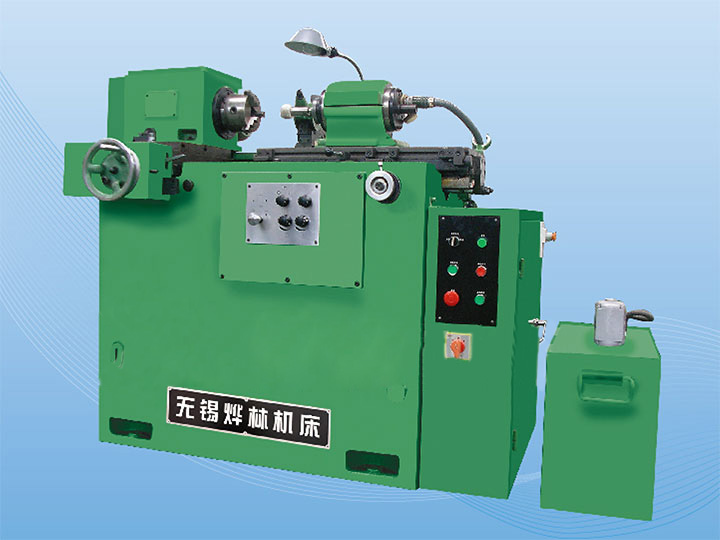
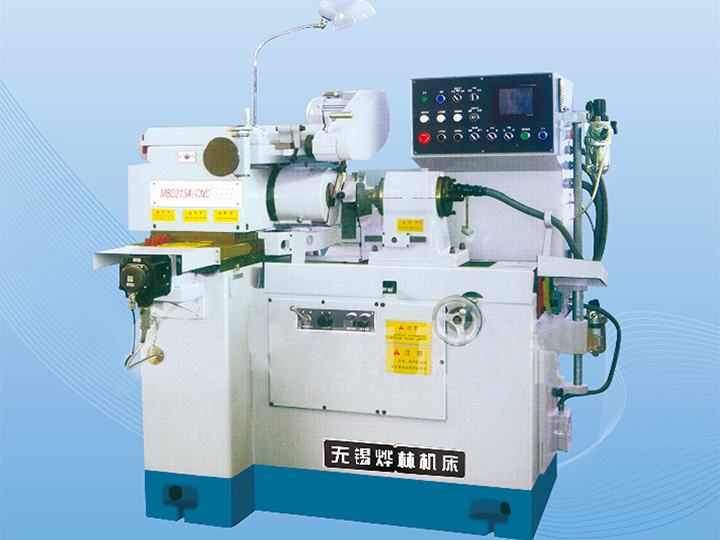
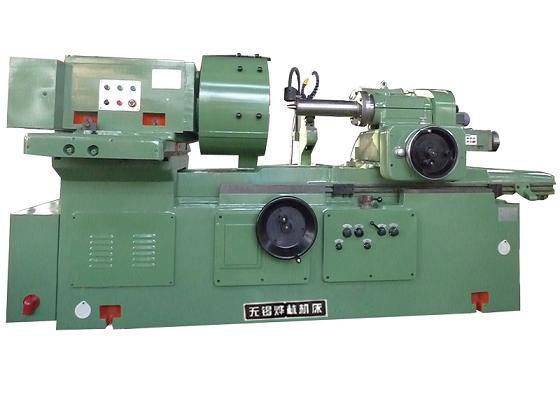
crankshaft grinder. Operator-driven workhead rotation, manual infeed, manual steady-rest adjustment. Best for diesel engine rebuild shops, marine engine repair, and one-off custom crankshafts. Cycle time per pin: 5–15 minutes.
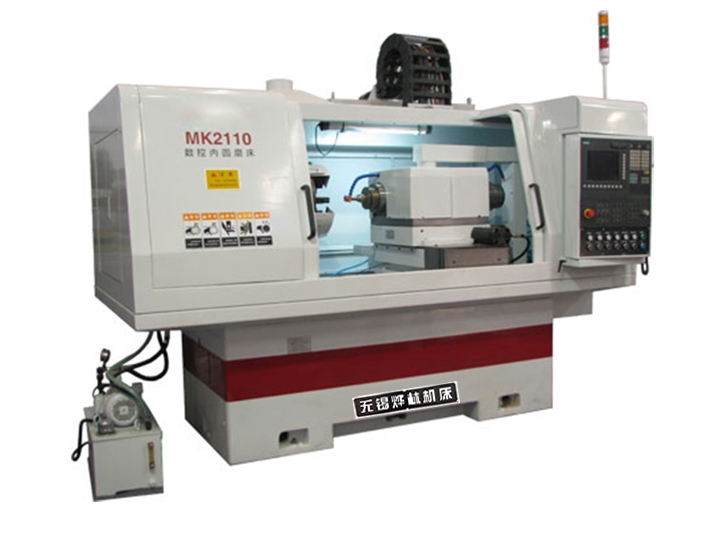
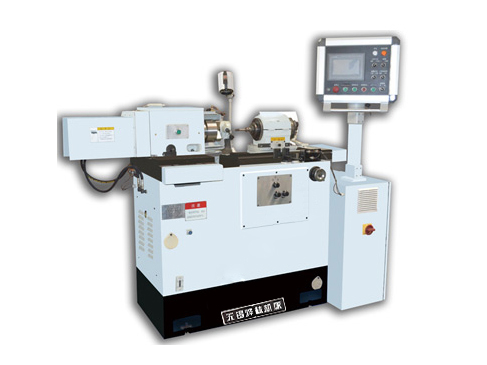
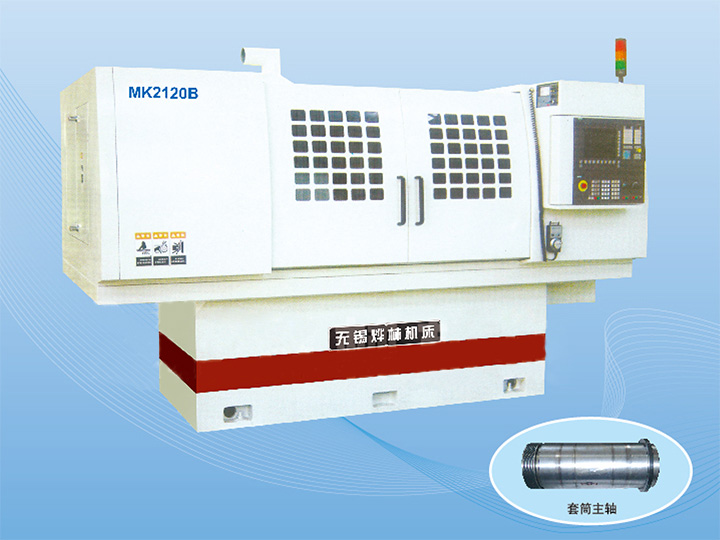
NC crankshaft grinder. Servo-driven workhead indexing (the operator dials in the crank angle), automatic infeed, automatic wheel dresser. Best for medium-volume production — aftermarket replacement crankshafts, heavy-equipment rebuild, small-batch OEM. Cycle time per pin: 3–8 minutes.
CNC crankshaft grinder. Full servo control of all axes, automatic loading, in-process gauging, optional polishing station. The right answer for high-volume OEM production (passenger car, motorcycle, marine, genset). Cycle time per pin: 1–3 minutes.
Yelin builds both NC and CNC crankshaft grinders. The CNC line covers automotive crankshafts from 200 mm to 1500 mm length; the NC line covers aftermarket and rebuild shops.
Why Crankshaft Geometry Demands Special Tooling
A standard cylindrical grinder can grind a journal — the wheel does not care what the part looks like. But the indexer on a cylindrical grinder is built for round parts. A crankshaft is round in one section, off-center in the next, and round again in the third. The grinder's workhead has to:
Drive the shaft from a single reference (typically the center axis of the main journals).
Rotate the shaft by an exact angle between pins so the next crankpin sits on the grinding axis.
Hold the steady rest in exactly the right position to support the pin without interference with the adjacent throws.
This is why you cannot grind a crankshaft on a regular cylindrical grinder — the workhead does not index, and the steady rest cannot get close enough to the pin to support it.
Specifications That Matter When Buying
Brochures headline "max workpiece length" and "max workpiece weight." Those are not the numbers that decide whether a machine fits your shop. The ones that matter:
Max workpiece length and weight. Check both. A 1500 mm-long crankshaft weighs 30–80 kg; make sure the workhead can swing that weight at the indexed RPM.
Max journal diameter. Standard machines cover 50–150 mm. Heavy-duty crankshafts for marine engines go to 400 mm; the workhead has to be sized for this.
Indexing accuracy. The workhead has to index to within 0.01° of the calculated crank angle. Lower accuracy shows up as imbalance and vibration.
Wheelhead power. Look for 7.5 kW minimum on a production machine. Below that, cycle time suffers.
Steady-rest rigidity. The steady-rest is the unsung part of the machine. Cast-iron, well-braced steady rests support the pin without chatter. Lightweight or poorly-braced steady rests turn finish into scrap.
Coolant flow. Crankshaft grinding uses a lot of coolant at high flow. 30–60 L/min at the wheel, plus separate flow for the steady-rest shoe.
Tolerances That a Good Crankshaft Grinder Holds
Numbers below are typical for a CNC crankshaft grinder on automotive and light-truck crankshafts. Marine and heavy-equipment crankshafts run 20–40% looser because of part size.
|
Parameter |
Typical tolerance |
|
Crankpin diameter |
±0.005 mm |
|
Crankpin roundness |
≤ 0.002 mm |
|
Crankpin cylindricity |
≤ 0.003 mm over pin length |
|
Crankpin surface finish |
Ra 0.2–0.4 μm |
|
Main journal roundness |
≤ 0.002 mm |
|
Main journal cylindricity |
≤ 0.003 mm over journal length |
|
Crankpin-to-main-journal concentricity |
≤ 0.005 mm |
|
Surface finish on fillets |
Ra 0.4–0.8 μm |
For higher-performance engines (motorsport, high-power diesel), the crankpin concentricity drops below 0.003 mm and surface finish drops below Ra 0.2 μm. That requires a high-rigidity CNC crankshaft grinder with in-process gauging and a vibration-controlled foundation.
Wheel Selection for Crankshaft Grinding
The wheel is the consumable that decides the surface finish and the cycle time. Common specs for a crankshaft grinder:
Grit: 46–60 for roughing on cast iron or forged steel crankshafts; 80–120 for finishing.
Grade: J–K for soft steels (below 250 HB); L–N for hardened (above 60 HRC).
Bond: Vitrified for general use; resin for high-stock-roughing on forged crankshafts.
Wheel diameter: 600–900 mm typical; smaller machines use 400–500 mm wheels.
Dressing: Single-point diamond dresser, automatic on CNC machines. Dress frequency: every 5–20 parts depending on stock removal.
For forged-steel crankshafts, use a softer-grade wheel and dress more often. For hardened (60+ HRC) automotive crankshafts, use a harder-grade vitrified wheel and reduce infeed to 0.002–0.005 mm per pass.
Common Defects and How to Diagnose Them
Crankshaft grinding fails in recognizable ways:
Crankpin taper. Cause: steady rest not positioned correctly, or wheelhead thermal drift. Fix: recheck steady-rest height, allow 15−30 minute warm-up before finish pass.
Surface burn (temper colors). Cause: insufficient coolant at the contact zone, or wheel loading. Fix: open coolant nozzle, switch to coarser grit or softer grade, dress more often.
Chatter marks. Cause: wheel grit too fine for the material, or steady-rest resonance. Fix: switch to coarser grit (46–60), stiffen steady-rest, lower infeed.
Out-of-index pin position. Cause: indexing pin worn, drive dog loose. Fix: replace indexing pin, re-shim drive dog. If the pin is offset by 0.05 mm, the crank throws unevenly and the engine vibrates.
Out-of-round pin. Cause: spindle deflection, workhead bearing wear. Fix: check spindle runout (should be under 0.002 mm), check workhead bearing preload.
Standard vs NC vs CNC: When to Buy Which
The decision is mostly about batch size and the tolerance your customer audits.
Standard (manual). Right for engine rebuild shops, marine and locomotive repair, low-volume custom shafts. Operator skill matters more than machine features. Cycle time: 5–15 min per pin.
NC. Right for medium-volume aftermarket crankshafts (replacement parts for truck, bus, agriculture engines). Adds automatic infeed and dressing without the cost of full CNC. Cycle time: 3–8 min per pin.
CNC. Right for OEM production — passenger car, motorcycle, genset, small diesel. Adds automatic loading, in-process gauging, and lights-out operation. Cycle time: 1–3 min per pin.
Capital cost scales roughly 1:2:4 from standard to NC to CNC, and throughput scales roughly 1:2:4 the same way. The ROI calculation follows.
Crankshaft Grinder ROI: A Worked Example
A diesel engine rebuild shop grinds 25 crankshafts a week, 4 pins per crank, 100 pins/week total. Two shifts, 50 weeks/year — 5,000 pins/year.
Standard machine: 10 min/pin average, requires one operator at 100% attention. 5,000 × 10 = 50,000 operator-minutes ≈ 830 operator-hours. At $25/hr loaded = $20,800/year labor. Plus 1.5 wheels/shift at $50 = $37,500/year wheels. Total operating cost: ~$58,000/year.
NC machine: 5 min/pin average, one operator supervising 3 machines. 5,000 × 5 = 25,000 minutes ≈ 420 operator-hours. At $25/hr loaded = $10,400/year labor. Wheels: 1.0/shift at $80 = $40,000/year. Total: ~$50,000/year operating.
CNC machine: 2 min/pin average, one operator supervising 5 machines. 5,000 × 2 = 10,000 minutes ≈ 170 operator-hours. At $25/hr = $4,200/year. Wheels: 0.8/shift at $120 = $32,000/year. Total: ~$36,000/year operating.
Add the capital cost: standard $80K, NC $180K, CNC $400K. CNC pays back the $320K difference in roughly 6–8 years on labor + wheel savings. CNC pays back faster if the shop bills more than $200/pin of grinding time, which most do.
Common Buying Mistakes
Buying CNC to "future-proof" without enough volume. A CNC sitting idle between setups is more expensive than a manual sitting idle.
Under-sizing the workhead. A workhead rated for 200 mm journals cannot swing a 350 mm marine journal at speed. Confirm the workhead rating against your largest pin, with margin.
Ignoring the steady-rest. The steady-rest decides whether you can hit 0.002 mm roundness or not. Ask the manufacturer for steady-rest rigidity spec, not just a photo.
Skipping the loader. On a CNC crankshaft grinder, automatic loading is the difference between "1 operator per machine" and "1 operator per 5 machines." That is the labor math the ROI depends on.
Choosing a wheel-head with too little power. For heavy-stock forged-steel crankshafts, you want 11 kW minimum. A 5.5 kW wheelhead will burn the part.
FAQ
Q: Can a regular cylindrical grinder grind a crankshaft?
A: No. A standard cylindrical grinder does not have an indexing workhead or a traveling steady rest close enough to support a crankpin. You need a crankshaft grinder or a universal cylindrical grinder with a crankshaft workhead attachment.
Q: What is the difference between a crankshaft grinder and a camshaft grinder?
A: Different workhead kinematics. A crankshaft grinder indexes the shaft to expose each crankpin on a fixed axis. A camshaft grinder follows the cam profile with a master cam or a servo-driven workhead, because cam lobes are not round. See Camshaft Grinder: How It Works, Tolerances and Modern Trends for the camshaft side.
Q: How much does a crankshaft grinder cost?
A: Indicative FOB Wuxi prices in 2026: standard manual crankshaft grinder, US $20K–$45K for small (up to 1000 mm length); NC crankshaft grinder, US $80K–$200K for medium-volume production; CNC crankshaft grinder, US $250K–$600K for OEM production with automation.
Q: What tolerances can a crankshaft grinder hold?
A: Crankpin roundness under 0.002 mm, cylindricity under 0.003 mm, surface finish Ra 0.2–0.4 μm. Crankpin-to-main-journal concentricity under 0.005 mm on a CNC machine.
Q: How long does it take to grind one crankshaft?
A: Depends on machine and pin count. A manual machine on a 4-cylinder automotive crank: 40–60 minutes including setup. An NC machine on the same crank: 20–30 minutes. A CNC machine with auto-loading: 8–15 minutes.
Q: What is the typical wheel life on a crankshaft grinder?
A: One vitrified wheel handles 50–200 pins depending on stock removal, material, and dressing discipline. On a CNC machine with auto-dress, expect 100–200 pins per wheel on forged steel, 200+ pins per wheel on hardened cast iron.
Q: Do I need a steady rest for crankshaft grinding?
A: Yes, always. The steady rest supports the journal during grinding. Without it, the pin deflects under the cutting force and you lose roundness. A properly set steady rest is the difference between 0.005 mm roundness and 0.002 mm.
Q: Can a CNC crankshaft grinder grind a camshaft?
A: Some CNC crankshaft grinders accept a camshaft profile-grinding software module and a master cam, allowing them to grind camshafts as well. Pure camshaft production usually goes to a dedicated camshaft grinder for cycle time reasons.
Bottom Line
A crankshaft grinder is a special-purpose cylindrical grinder with an indexing workhead and a traveling steady rest. The right configuration depends on batch size: manual for rebuild shops, NC for medium-volume aftermarket, CNC for OEM production. Yelin's crankshaft grinder line covers all three segments.
If you are sizing a crankshaft grinder, send us the crank length, pin diameter, journal-to-pin offset, material/hardness, and weekly volume. We will respond with a configuration, indicative price, and a payback calculation. See the full Yelin grinder product line or contact our engineering team.
 English