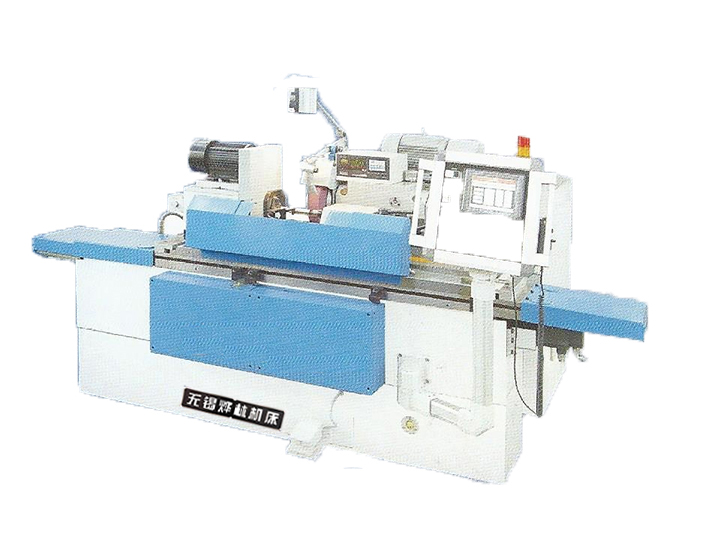
Curve Grinder: Professional Equipment and Technical Analysis for Precision Complex Contour Machining
Release time:2026-04-03 Visits:549
Curve grinder is a specialized grinding equipment used for machining workpieces with complex contours in the field of precision manufacturing. It achieves high-precision form grinding through profiling or optical projection technology. This equipment plays an irreplaceable role in mold manufacturing, tool production, and precision parts processing, serving as a key device for realizing high-precision complex curved surface machining.
The core technologies of curve grinders are mainly divided into two categories. Mechanical profiling technology precisely transmits the movement trajectory of the profiling contact on the enlarged template to the grinding wheel through a proportional scaling mechanism, achieving accurate replication of the workpiece's surface shape. This technology is particularly suitable for mass production of form tools, precision templates, and mold segments, ensuring product consistency and precision stability. Optical projection technology, on the other hand, magnifies and displays the workpiece contour on a screen through a high-magnification projection system. Operators precisely control the grinding wheel to remove material point by point by comparing with the preset enlarged pattern until the actual machining contour completely matches the theoretical line. This method is especially suitable for single-piece or small-batch production of small complex curved surface parts, offering high flexibility and adaptability.
In terms of machining capability, curve grinders typically use specially made thin grinding wheels, enabling high-precision machining with an accuracy of ±0.01mm. The equipment is equipped with a complex motion mechanism system. In addition to high-speed rotational movement, the grinding wheel can perform multi-directional precision feeding and accurate angle adjustment. The worktable features high-precision coordinate movement functions, capable of meeting grinding requirements for different curvature radii and complex geometric shapes. It should be noted that when machining closed contours or internal corner structures, fine-grained special grinding wheels and special dressing processes must be used to ensure contour clarity and dimensional stability.
Modern curve
grinders continuously integrate digital and automated elements based on traditional technologies. Some advanced equipment has begun to adopt numerical control systems and online measurement technologies, further improving machining precision and efficiency. The operation interface has also become more user-friendly, lowering the technical threshold and making precision machining of complex curved surfaces easier to achieve.
The technical advantage of curve grinders lies in their unique working principle and precise mechanical structure. Through mechanical profiling or optical comparison methods, the equipment can achieve high-precision machining of complex curved parts, solving the precision forming problems that are difficult to handle with traditional machining methods. As manufacturing industries continue to increase their requirements for product precision, the application range of curve grinders in the field of precision manufacturing is continuously expanding.
When selecting a curve grinder, factors such as the characteristics of the machining material, workpiece dimensional accuracy requirements, production batch size, and investment budget need to be comprehensively considered. Different technical routes have their own advantageous fields: mechanical profiling is suitable for high-volume, high-precision machining, while optical projection is more suitable for single-piece or small-batch production of complex curved surfaces. Correct selection and use of curve grinders can significantly improve product quality and production efficiency, creating greater value for manufacturing enterprises.
 English